Thomas Eakins : The Absolute Male
Category: Books,Arts & Photography,History & Criticism
Thomas Eakins : The Absolute Male Details
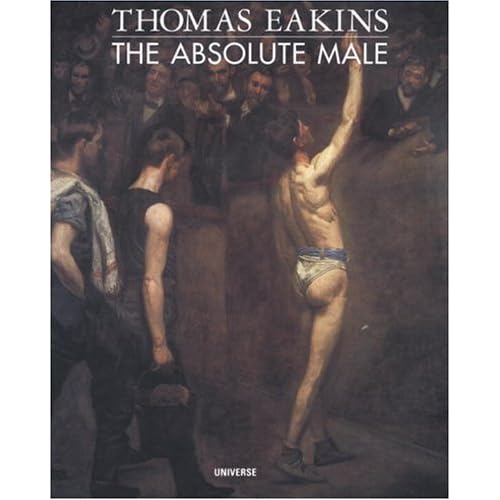
From Library Journal Thomas Eakins's (1844-1916) reputation has long since recovered from the ostracism he suffered when he exposed female drawing students at the Philadelphia Academy of Art to nude male models and was forced to quit teaching. In recent years, the rehabilitation of this 19th-century realist painter has continued, with several books and museum retrospectives of his work. Perhaps, then, it was inevitable that the erotic potential of Eakins's working materials-extensive photographic documentation of the bodies of his male models and students-would be seized upon. This sexy but unnecessary book compiles many of his photographs of nude youths, often engaged in such unlikely athletic pursuits as wrestling, boxing, or tugs-of-war while in the buff in some Arcadian setting. Translated onto canvas by Eakins, these beautifully composed images became lyrical and timeless. Few of the final paintings are seen here, however. Lacking the interpretive analysis contained in Kathleen Foster's excellent Thomas Eakins Rediscovered, this thin volume is instead best thought of as Victorian-era eye candy. Libraries seeking insight into Eakins's visual methods would be better served by Foster's book.Douglas F. Smith, Oakland P.L., CA Copyright 2002 Reed Business Information, Inc. Read more From Booklist Abstraction gets the most ink whenever modern art is the subject, but surely another vital modernist development was the revival of the male nude. Thomas Eakins (1844-1915), one of America's greatest painters and art teachers, became enthralled with the male nude as a student in Europe and under the influence of the Renaissance masters. He and a fellow student posed nude for one another then, and when he started teaching back in Philadelphia, he regularly had a male student pose. For reference purposes, he made studio photographs resembling Eadweard Muybridge's famous motion studies (he had worked with Muybridge), series of single-figure images regarding the body from different angles, and outdoor groupings, the best-known of which were models for his painting Swimming. Esten discusses Eakins' use of male nudes, which got him fired from one post when he pulled the loincloth from a male model in a class including female students, and presents a lovingly reproduced selection of Eakins' photographs and a few paintings based on them. Ray OlsonCopyright © American Library Association. All rights reserved Read more About the Author John Esten has created and designed many books on art, photography, and interior design. A former art director at Harper's Bazaar and L'Officiel USA magazine, he has been guest curator at the Guild Hall Museum in East Hampton, New York, and at the International Center of Photography in New York City. His previous titles include Sargent: Painting Out of Doors, John Singer Sargent: The Male Nudes, and Why Don't You. Read more


Reviews
This is a beautifully produced little volume of Eakins's photographs and paintings of nude males (the phrase "absolute male" is a journalistic euphemism for male art class models stripped of their posing straps). The text is thin and doesn't really say anthing new. The paintings are also likely to be familiar to anyone who has studied Eakins and have been frequently reproduced in more comprehensive catalogs. Even the photographs, called "Naked Series" because they show a single nude model from multiple angles, have been reproduced previously. Dating from the 1880s these may interest the student of early photography. While author John Esten seems to consider these to be works of art in their own right, they clearly served primarily as reference material for Eakins. This is most obvious in the swimming pictures and in one painting called "The Wrestlers" which--muscle for muscle, sinew for sinew--is based on a photograph he took of fellow art students in Paris in 1899 (pages 68 and 69).The book includes a 2-page chronology of Eakins's life and a bibliography. The latter is a very short list; it only cites 19 works, two of which are books of poetry (Whitman's "Leaves of Grass" makes sense, but I fail to see the relevance of "The Complete Poetry and Prose of William Blake".) Very relevant but not cited is Helen Cooper's excellent 1996 book "Thomas Eakins: The Rowing Pictures" (ISBN 0-300-06939-1). If your primary interest is a book of beautifully reproduced images, these shortcomings will not bother you.